
Home / Virtual Data Center
Build a secure cloud infrastructure for your business
Deploy a secure, isolated VDC (virtual data center) cloud environment with flexible VM resources, private networking, managed routing, NVMe storage, and usage-based billing, so your team can launch faster, control costs more precisely, and scale infrastructure when workloads grow rapidly.
Scale your business processes with Fiberax
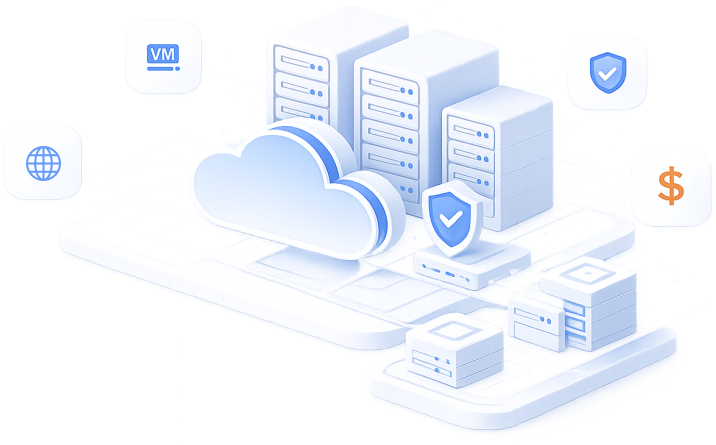
Our virtual data center services are designed for companies that need a full dedicated cloud environment with direct control over computing, storage, networking, and security decisions. A VDC virtual data center on Fiberax starts as one isolated workspace and expands step by step as business requirements change, which makes it practical for both planned growth and fast operational changes.

We let you customize CPU, RAM, and storage for each virtual machine configuration independently. This helps you assign more power to the database, keep lighter resources on utility servers, and avoid paying for oversized options where they are not needed. It is a more efficient offer for mixed workloads than forcing every application into one uniform server size.

Fiberax virtual data center allows users to deploy Linux, Windows, and marketplace applications from one platform. The provisioning flow supports fast VM creation from operating system templates and ready-to-use apps. This shortens launch time for new projects, improves standardization across teams, and reduces manual preparation.

We support isolated VLAN-based networking between virtual machines, with private networks, custom subnets, and DHCP. This architecture gives you a clear way to separate front-end traffic, databases, management access, backup flows, and internal services. Segmentation improves control, simplifies policy design, and reduces operational risk when several applications run in the same cloud environment.

We provide managed routers based on VyOS, with NAT, firewall, DHCP, and port forwarding available from the virtual data center dashboard. This creates a centralized control point for ingress, egress, and service publishing. You can manage public access at the router layer, keep internal machines private, and maintain cleaner network governance as the environment grows.

Our model is based on pay-as-you-go billing, with hourly charging and no monthly commitment for the VDC service. This matters for businesses with changing demand, staged launches, temporary environments, or uneven seasonal load. Your finance team gets a structure that is easier to approve, while your technical team gains room to scale up, scale down, or remove existing processes without redesigning the whole platform.

We structure pricing for CPU, RAM, NVMe storage, public IPs, and backup as separate components. This means you can assemble the environment as a workload-specific resource pool rather than as a rigid preset package. For businesses replacing a fragmented virtualized data center, this approach improves cost alignment because each component can be expanded according to actual demand, not guessed capacity.
Build a secure cloud infrastructure for your business
Our virtual private data center is best suited to workloads that need isolation, controlled network design, flexible resource allocation, and predictable administrative access. Unlike many fixed virtual data centers, our model lets you create only the infrastructure layers you currently need, then expand them as applications, users, and data volumes increase.

Our virtual data center services fit ERP platforms, internal portals, client dashboards, and custom business systems that need separate application, database, and utility layers. Private networking and managed routing make it easier to keep service roles isolated, while independent VM sizing helps you allocate more resources only to the parts of the stack that carry the main load.

We support online store infrastructure built from dedicated machines for the web layer, database, email, analytics, monitoring, and secrets management. That solution is useful for retailers that need better separation between customer-facing services and background systems.

Our virtual private data center works well for source control, runners, automation, monitoring, documentation, and test systems inside one controlled workspace. This reduces dependency on scattered third-party tools and gives your team one place to manage networking, machine resources, and access rules.

You can use our VDC as a hosting for business email, conferencing, file storage, automation tools, analytics, and password management in one segmented environment. The benefit is direct control over where services run, how they connect, and how internal access is managed across departments, contractors, or branch teams.

Our service is a strong fit for BI technology, automated event collection, scheduled jobs, status monitoring, and support tools that do not belong on the same machine as production applications. Isolated VMs allow each function to run with its own compute profile.
When one business supports multiple clients, brands, or internal entities, separate networks and routed access to virtual data centers become important. Our model allows you to create distinct spaces inside one controlled platform instead of mixing everything into one flat server layout.
It works best for workloads that need multiple tiers, controlled networking, or separate service roles. Typical examples include:
These deployments benefit from isolated machines for databases, front-end services, backups, and management tools, rather than forcing everything into a single server with one shared configuration.